Monday, April 28, 2025
Because we were able to see the Acropolis yesterday, we had a day off today.
 |
We had breakfast at Mamsen's, which features
Norwegian cuisine, including 'Mom's' waffles |
 |
| We also did a couple loads of laundry |
Tuesday, April 29, 2025
 |
| Katakolon Harbor as seen from our stateroom |
 |
Our morning shore excursion took us to the
archaeological site of Olympia, and then we
had to cross the Kladeos River bridge |
 |
The Kladeos River, in addition to the nearby Alfeios River,
may have been the two rivers harnessed by the
mythical Hercules to clean the Augean Stables |
 |
Cercis siliquastrum/European Redbud has
blossoms and leaves at the same time |
 |
How can you tell if these are Roman or Greek ruins?
The Romans used the thinner yellow Roman bricks |
 |
Section of the gymnasium (2C BCE), which was the
venue for athletes to train for the ancient Olympic Games |
 |
More of the gymnasium, which was for physical training,
as well as education in music, math, grammar and reading |
 |
| Palaestra (3C BCE) was the training area for wrestlers |
 |
Philippeion Temple (3C BCE) is a
circular building to celebrate a
battle victory by Philip of Macedon
and was completed by his son,
Alexander the Great |
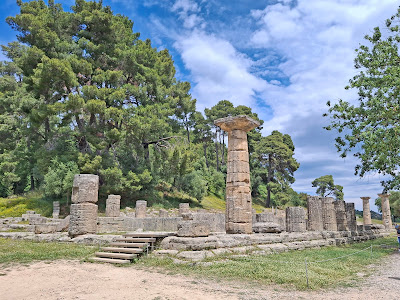 |
Temple of Hera (c 590-580 BCE) is the oldest temple
at Olympia |
 |
Our guide, Dimitra, shows a
rendering of the Temple of Hera |
 |
| The Altar of Hera is where the Olympic torch is lit, even today |
 |
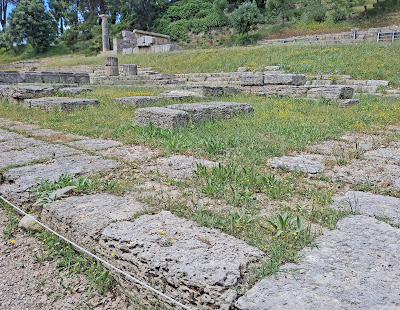
| Nymphaeum (156-160 CE) supplied fresh spring water |
 |
| Metroön/temple (4C BCE) dedicated to Rhea/mother of the gods |
 |
Steps to the twelve treasuries (6C BCE) that were used
to store votive offerings by Greek colonies |
 |
On the road leading to the stadium were pedestals
of statues of the Olympic winners |
 |
Location of Echo Stoa, a colonnade with acoustics
such that a sound was repeated seven times |
 |
| Entering the stadium (776 BCE) |
 |
| 'Athletes' coming out of the stadium 'tunnel' |
 |
| The stadium is 212.54 m/697.3' long |
 |
| The judges' stand is across the 'track' |
 |
During the 2004 Summer Olympics this
was the venue for the shot put |
 |
| The starting line |
 |
Oak trees were planted at the Temple of Zeus,
as a symbol of his strength and power |
 |
| Temple of Zeus (472-456 BCE) |
 |
The Temple of Zeus was made with a coarse local
shell conglomerate that was once covered with stucco |
 |
Base of Statue (420 BCE, by Paeonios)
of Nike/Victory |
 |
Temple of Zeus with one column rebuilt to show its height,
and others left as they were when pulled down
during the Byzantine period of Christianity |
 |
Bouleuterion/Council House (96-4C BCE) where the
Olympic athletes and judges made their oaths of fair play |
 |
Leonidaion/Hostel (330 BCE) where dignitaries and
athletes lodged during the Olympic Games |
 |
| Theokoleon/Priest's House (5C BCE) |
 |
Free time in the town of Olympia;
the main street of Praxiteles Kondylis |
 |
Beekeeper mannequin and honeycomb
frame at a shop selling honey |
 |
| Town Square |
 |
| Church of the Assumption of the Virgin Mary |
 |
| Sculpture of an Olympian shot putter |
 |
Mamos Beer was created in 1876
and re-released in 2017 |
 |
Torch of Peace (1992, by Georgios Glyptis
and George Schbatsampaia) is based
on Nike/the winged goddess of victory |
 |
Bronze tripod cauldron like those that were
awarded to victors in the Olympic Games |


No comments:
Post a Comment