Sunday, May 25, 2025
Because there was a Tyler Arboretum organized walk to Pink Hill in May, I thought that this was when the hill would be pink.
At the Tyler reception, a couple seemed to be pondering the $15-each admission, so we invited them as our guests. Turns out they are from New Jersey! We had a specific goal today, so left them on their own.
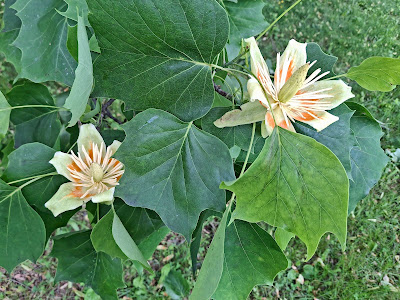 |
We don't get to see these blossoms still on the
Liriodendron tulipifera/Tulip Tree |
 |
Passing the Sequoiadendron giganteum/
Giant Sequoia |
 |
Gate 7 let us through the deer fence surrounding
the area of Tyler Arboretum with gardens |
 |
| We had to cross Painter Road |
 |
| Deutzia gracilis/Slender Deutzia, a non-native |
 |
| Small fording of rain runoff? |
 |
| Plank bridge over a feeder to Dismal Run |
 |
| Rope railing for steps |
 |
Gate through another deer fence
surrounding the Pink Hill area |
 |
| Hmm, dry grasses on Pink Hill |
 |
| Partially cleared area? |
We did not think to take a photo of the partially burned section; however, Tyler Arboretum is conducting controlled burns in order to restore this unusual area of serpentine barrens. The serpentine barrens are a geological rarity occurring only in patches, mostly in the northeast United States, and particularly in Maryland and southeast Pennsylvania. They are remnants of an ocean floor that was pushed up over 200 million years ago, when the African continent collided with the North American continent.
Here the soil is unable to support the usual plants, animals and insects in the way that other areas of the Arboretum could. Its soil contained high concentrations of minerals, such as magnesium, nickel and chromium, and not enough of the nutrients (especially calcium) needed to support new growth. Aside from that, beneath the thin layer of soil was a rare, green-cast stone, named serpentinite. Thus was created an ecosystem that was home to an extraordinarily diverse group of plants and animals, including several rare, threatened and endangered species. Today those grasslands are quickly disappearing and even Tyler’s plot has been reduced, mostly taken over by spruce and juniper, from the original 14 acres to its present three acres.
 |
The upper part of Pink Hill close to the fence on
Barren Road, may be a restored section; we learned from
another hiker that the Phlox subulata/Moss Phlox actually
blooms in April, giving the hill a pink color |
 |
Pink Hill Trail is a lollipop trail,
so the loop takes us through another gate |
 |
A section of a bordered path leads to
a plank bridge crossing Dismal Run |
 |
Despite many days of rain, the amount of
water in Dismal Run is, apparently, dismal |
 |
Strong fragrance from Lonicera japonica/
Japanese Honeysuckle that is invasive |
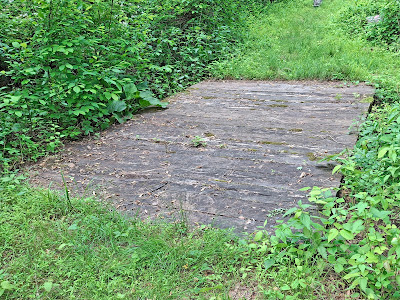 |
The small plank bridges over run-offs heading to
Dismal Run were often overgrown with greenery |
 |
The photo does not do justice to the 'pop' color of
Rhododendron calendulaceum/Flame Azalea
|
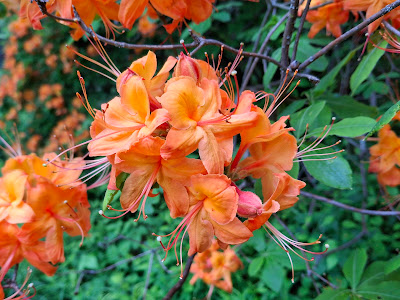 |
| Flame azalea blossoms at peak |
 |
| Kalmia latifolia/Mountain Laurel |
 |
Why was that father holding up his daughter
at the base of this tree: oh, a tiny bird nest |
 |
| Wister Rhododendron Garden |
 |
| Gnome entomologist at the pond |
 |
A nesting tube that last year held
Anas platyrhynchos/Mallard Ducks |
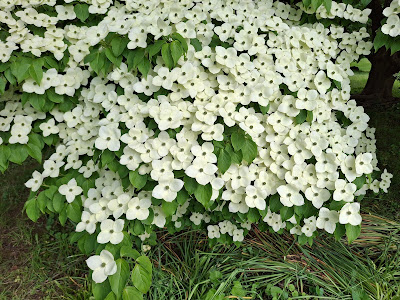 |
| Cornus kousa/Kousa Dogwood |
 |
| Pollinator Preserve |
 |
| Cornus kousa 'Miss Satomi'/Pink Dogwood |
 |
Sedum kamtschaticum/Orange Stonecrop;
orange? |
 |
| The aftermath of flame azalea blooms |
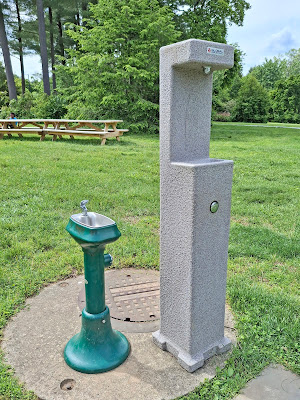 |
Functioning water fountain and
water bottle filling station |


No comments:
Post a Comment